
The dashboard looks great. Weekly actives are up. Output volume is up. The pulse survey says people love the new tools. By every metric your enablement team tracks, the AI rollout is working.
And somewhere downstream, the work is quietly getting worse.
A proposal goes out that doesn't quite match what was discussed on the call. An analyst's model has a subtle error nobody catches until the quarterly review. A policy doc cites a regulation that doesn't exist. A strategy deck lands in the board packet and sounds exactly like every other strategy deck the board has read this year, from every other company using the same tools.
Nobody has said it out loud yet. But the work is degrading, and the dashboards are cheering.
This is the AI failure nobody is measuring: adoption without judgment.
How slop happens
Polish gets confused for correctness. A well-formatted response with confident prose and a clean structure reads authoritative, so it ships. The user didn't verify the citations because the citations looked real. Didn't sanity-check the numbers because they were laid out in a tidy table. Didn't push back on the recommendation because it was written in the calm, hedged voice of someone who sounds like they know what they're talking about.
The verification muscle atrophies. People who used to catch errors stop looking for them, because the output feels finished. It came back fast, it reads well, it has the right shape. The instinct to poke at it fades.
And once that instinct fades, slop stops being an occasional accident. It becomes the default output of your organization.
Junior staff are the biggest casualty
The reps that used to build professional judgment (draft it badly, get it marked up, draft it again, slowly develop taste over years of feedback) are being skipped.
New employees are outputting senior-looking work on day one. The memos are polished. The analyses are structured. The client emails are grammatical. And underneath, the pattern recognition that would let them notice when the AI is subtly wrong isn't developing, because they never had to build it.
Research from Anthropic backs this up. In a randomized controlled trial of 52 developers learning a new Python library, those with AI assistance scored 17% lower on a follow-up comprehension quiz than those who coded by hand, roughly two letter grades. The gap was largest on debugging questions, precisely the skill teams need to catch AI errors. And the speed gains? Not statistically significant.
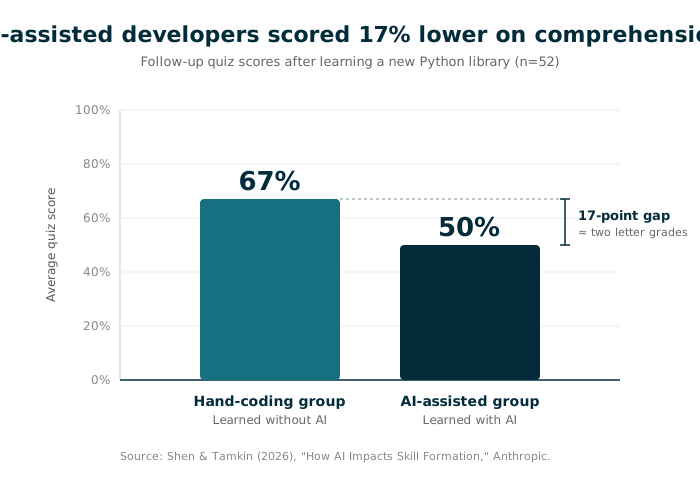
Source: Shen & Tamkin (2026), "How AI Impacts Skill Formation," Anthropic.
You are producing a generation of professionals who cannot tell good work from mediocre work in their own field. They can produce it. They cannot evaluate it. When the AI drifts, they will not notice. When a client asks a follow-up question that goes past what the AI generated, they will not have the underlying model to answer it.
This is a five-year problem showing up as a five-month productivity win.
The homogenization problem
Every memo, email, and strategy doc starts sounding the same. The specific texture that made your company's writing feel like your company's writing gets sanded down into a competent, faintly generic register.
Your brand voice, your point of view, the thing that differentiated your work from your competitors' work, quietly disappears. And because everyone in your industry is using the same tools with the same default prompts, you are converging on the same voice as the people you are trying to beat.
The pitch decks look the same. The thought leadership posts sound the same. The customer emails have the same rhythm. The market is being flooded with fluent, competent, indistinguishable output, and your organization is contributing to the flood without noticing.
Why none of this shows up on the dashboard
Usage metrics look great. Volume looks up and to the right. Pulse surveys say people love the tool.
The rework, the eroded client trust, the confident errors that shipped, land weeks or months later, often on someone else's P&L. By the time quality decay is visible in real outcomes (churn, complaints, a regulator's letter, a lost deal), it has been building for a year.
There is a cost angle to this too. When work has to be redone because the first draft was subtly wrong, the second and third attempts cost real money in tokens and real hours in human time. But the deeper cost is not the token bill. It is the quality of the work itself, and the trust your organization is spending down without realizing it.
The root cause: you skipped the craft
Your organization funded procurement. You funded infrastructure, SSO, security review, the whole compliance stack. And you skipped the layer in between: teaching people how to actually use AI well.
Using AI well is not one skill. It is four. Anthropic, working with Professors Rick Dakan and Joseph Feller, calls them the 4 Ds of AI Fluency, and we've built our training around them.
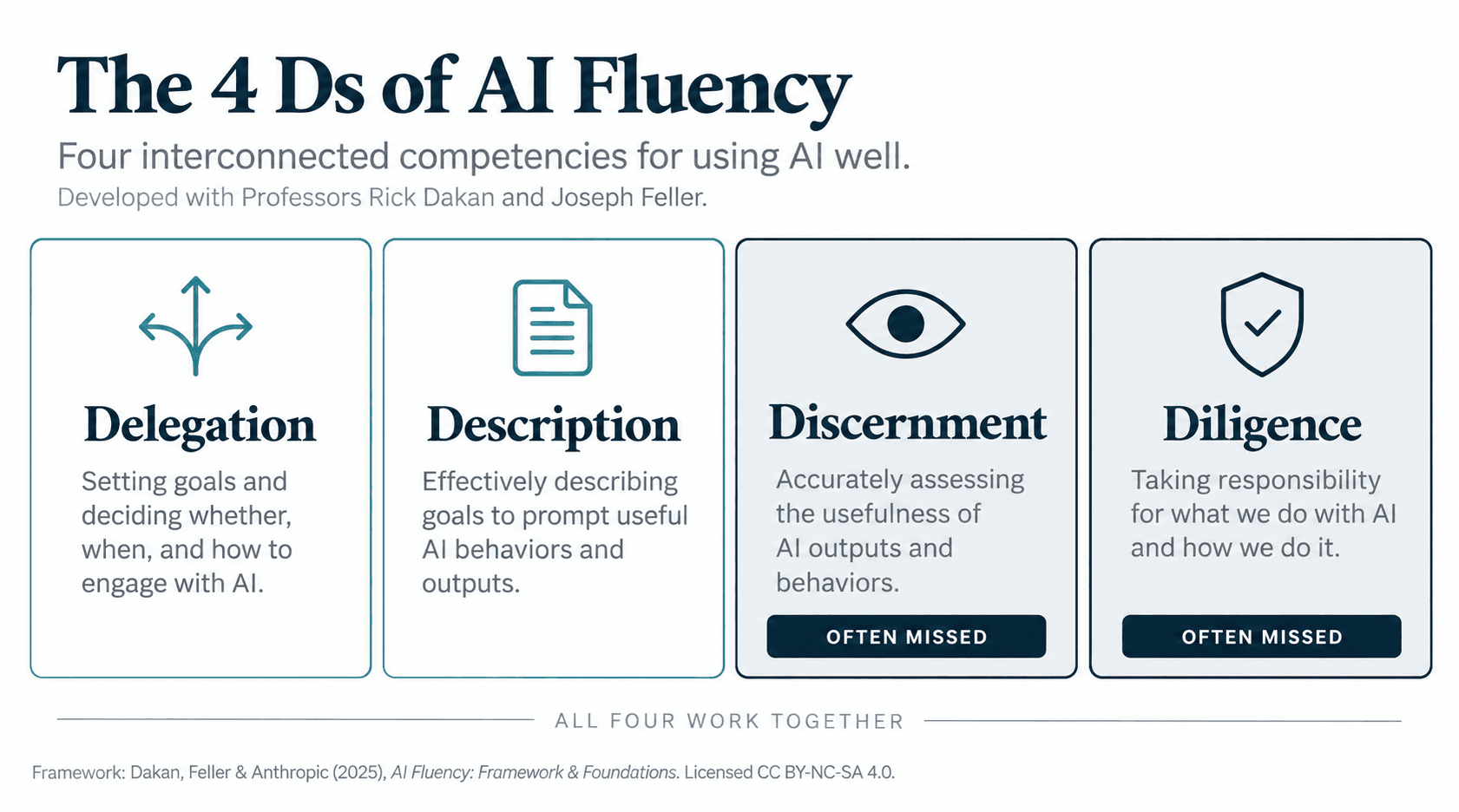
Delegation: setting goals and deciding whether, when, and how to engage with AI. Which work stays with the human, which goes to the AI, and how tasks get distributed between them.
Description: effectively describing goals to prompt useful AI behaviors and outputs. This is what most people mean when they say "prompting," and it is what most training programs teach.
Discernment: accurately assessing the usefulness of AI outputs and behaviors. Is this right? Is it good? Is it what I actually need? This is the skill that prevents slop, and it is the one almost no organization teaches.
Diligence: taking responsibility for what we do with AI and how we do it. Verification, transparency, and ownership of the final work, no matter who or what drafted it.
Slop is what happens when organizations train Description and skip Discernment. Everyone learns to prompt. Almost nobody learns to judge. And without Diligence, nobody takes responsibility for verifying what shipped. The tool becomes an amplifier for whatever quality standard the user already had, or didn't have, and the confident output overrides whatever instinct might have said "this isn't quite right."
Adoption without Discernment is worse than no adoption. At least the person without the tool knows they don't know.
What actually works
The fix is not a bigger training budget or a mandate from the CEO. It is building the layer you skipped, with Discernment as the centerpiece.
Teach Discernment before Description. Before you train people to prompt, train them to critique. Show them side-by-side examples of good AI output and mediocre AI output in their domain, and make them articulate the difference. People cannot produce quality work with a tool if they cannot recognize quality work from a tool.
Publish a "what good looks like" library per function. Not prompt libraries. Output libraries. Prompts vary. The standard for a good memo, a good analysis, a good customer email is stable, and teams need a concrete reference to calibrate against.
Run working sessions where the second half is critique, not generation. People bring real AI output and workshop what is wrong with it. That is where Discernment gets built, and it does not build in a 30-minute demo.
Build domain-specific "spotting slop" guides. What counts as slop in legal is different from what counts as slop in marketing, which is different from what counts as slop in engineering. Generic guidance does not develop domain judgment.
Protect the reps that build judgment, especially for junior staff. This is a Delegation call: deciding what work AI should touch and what work should stay fully human because the doing is the learning. If a new analyst never has to draft a bad memo and get it marked up, they will never learn to spot a bad memo the AI drafts for them. Design for that friction deliberately.
Measure quality-of-outcome, not usage. Sample outputs. Have senior people rate them blind, quarter over quarter. Track whether client-facing work is getting better or worse over time. If you are not measuring quality, you are trusting a dashboard that cannot see the thing that matters.
Leaders model "AI drafts, humans judge." Not by championing the tool in all-hands, which reads as performative, but by visibly sharing the edits they made to the AI's first draft. The norm you want is that the tool produces, the human decides. That norm gets set by what leaders do, not by what they say.
This is the work our team does with organizations. We train Anthropic's 4 Ds framework as a system, with particular focus on Discernment and Diligence, because that is where nearly every AI rollout quietly breaks.
The real question
Stop asking whether people are using AI. Start asking whether the work is actually good.
The dashboards that celebrate adoption are measuring the wrong thing. The right question is downstream, in the quality of what your organization actually produces, and whether the people producing it can tell the difference between good work and confident-looking work.
If you did nothing new for the next 90 days, would the work coming out of your company be better, worse, or the same? If the honest answer is "I don't know," you don't have an AI problem. You have a judgment problem, and the AI is making it invisible.
Fynix helps teams build the judgment layer that turns adoption into actual quality.
References
Shen, J. H., & Tamkin, A. (2026). How AI Impacts Skill Formation. Anthropic. https://www.anthropic.com/research/AI-assistance-coding-skills | arXiv:2601.20245
Dakan, R., Feller, J., & Anthropic. (2025). AI Fluency: Framework & Foundations. Released under CC BY-NC-SA 4.0. https://www.anthropic.com/ai-fluency