
You brought in a contractor because your team needs more capacity. The last thing you want is for that extra help to create even more work.
Yet that’s how the first few weeks often go. Senior engineers lose afternoons to setup questions. The new developer waits on permissions. Tickets stall because nobody explained an unwritten part of the system. And the sprint you hired someone to help recover slips anyway.
A good contractor should reduce pressure on your team, not add to it.
The difference is usually the ramp. When onboarding is treated as a defined process—not something everyone assumes will work itself out—a strong contractor can start contributing meaningful work quickly and move toward independence within the first month.
Here’s the 30-day approach we use.
Why slow onboarding costs more than contractor time
Contractor onboarding usually breaks down for a simple reason: ownership is unclear.
The hiring manager thinks IT is handling access. IT assumes the engineering lead will cover the technical setup. The engineering lead expects an experienced contractor to figure most of it out.
Meanwhile, the new developer is waiting for repository permissions, hunting through outdated documentation, and sending Slack messages to whoever seems most likely to know the answer.
Those interruptions have a cost beyond the contractor’s lost time.
Research from Gloria Mark and colleagues at UC Irvine found that people often took significant time to return to an interrupted task, frequently moving through other activities before resuming the original work (Mark, Gonzalez & Harris, CHI 2005).
23 min
AVERAGE TIME TO RESUME AN INTERRUPTED TASK (MARK ET AL., CHI 2005)
A contractor who is blocked all day can create a surprising amount of drag for everyone around them.
There’s also a human cost. A developer who spends their first week waiting starts questioning whether the engagement is organized. A team that spends its week answering preventable setup questions starts questioning whether the additional help is actually helping.
WHAT THIS ACTUALLY COSTS
Every preventable blocker is paid for twice: once by the contractor who is waiting, and again by the senior engineer who stops to unblock them.
Neither outcome is necessary.
Before day one: remove the preventable blockers
Anything that can be handled before the contractor starts should be handled before the contractor starts.
At a minimum, that means:
- Creating accounts for email, Slack or Teams, your project tracker, CI/CD tools, cloud environments, and other required systems
- Granting repository access at the correct permission level—and confirming it actually works
- Reviewing your environment setup instructions with someone who hasn’t used them recently
- Completing hardware, VPN, security, and authentication requirements
- Naming a primary point of contact for the first two weeks
- Selecting and documenting the contractor’s first ticket
One particularly useful test: ask someone to follow your setup documentation from scratch.
If nobody outside the core team has used the README in six months, there’s a good chance it contains assumptions, missing steps, or commands that no longer work.
The goal for day one is straightforward: the contractor should spend their time learning your system, not discovering your administrative gaps.
If they can clone the repository, run the application, execute the test suite, and understand where to start before lunch, you’ve removed most of the avoidable friction.
Week 1: build context before velocity
The temptation is to give a new contractor a backlog and immediately start measuring output.
That usually backfires.
Code written without enough context creates review cycles, rework, and questions later. You’re better off investing a small amount of time up front so the developer understands how your team and system actually work.
Focus on three things during the first week.
1. Give them a codebase tour
Have someone who understands the system walk through it for an hour.
Show them where requests enter the application, how the major components connect, where important business logic lives, and which parts of the codebase deserve extra caution.
Record the walkthrough.
That recording becomes useful not only for the contractor, but for every developer you onboard afterward.
2. Explain the language of the business
Every company develops its own vocabulary.
Maybe a “customer” is different from an “account.” Maybe “booking,” “reservation,” and “order” have distinct meanings in the product. Maybe one internal acronym describes a process nobody outside the company would recognize.
Write those things down.
A simple one-page glossary can eliminate dozens of small interruptions and, more importantly, prevent incorrect assumptions from making their way into the code.
3. Ship a real starter ticket
The first assignment should be small, useful, and capable of reaching production.
Not a fake exercise.
Choose something like a contained bug, a minor UI adjustment, a test that needs to be added, or a small change with a well-understood solution.
The point isn’t to test whether the contractor can solve a hard engineering problem. You already hired them.
The point is to validate the entire workflow:
environment → branch → code → pull request → review → deploy
If that ticket makes it through the full process during the first week, you know the onboarding pipeline works.
Week 2: make the first meaningful contribution
During week two, the contractor should begin taking on substantive work.
The assignment still needs to be chosen carefully. Look for something well scoped, relatively low risk, and contained enough that the developer can reason about the surrounding system without understanding the entire codebase.
Most importantly, give the ticket a clear definition of done.
Your existing engineers already know dozens of unwritten expectations. A contractor doesn’t.
Two practices are especially valuable here.
Pair on the first significant ticket
Schedule one or two focused pairing sessions.
They don’t need to last all day. An hour with an experienced teammate can transfer the kind of context that rarely appears in documentation: common patterns, historical decisions, naming conventions, dangerous shortcuts, and what reviewers are likely to flag.
That hour is usually cheaper than several rounds of review on a pull request that headed in the wrong direction.
Make your pull request norms explicit
Don’t assume every engineering team works the same way.
Tell the contractor:
- How large you expect PRs to be
- Who should review them
- How much explanation belongs in the description
- What testing is expected
- How quickly reviews normally happen
- When to ask for feedback before finishing the implementation
Experienced contractors have habits from previous teams. Unless you explain yours, they’ll reasonably fall back on what has worked elsewhere.
Weeks 3–4: move from support to autonomy
By the third week, the contractor should need less structure.
Ticket complexity can increase. Daily onboarding conversations can become less frequent. The developer should start pulling appropriate work from the backlog, participating more naturally in planning, and making decisions without needing constant confirmation.
You’re looking for a shift in the kinds of interactions they have with the team.
Signs that the ramp is working include:
- Pull requests need refinement rather than substantial rewrites
- Questions change from “How does this work?” to “Which approach would you prefer?”
- Ticket cycle time starts moving closer to the rest of the team
- The contractor begins identifying issues beyond the literal scope of their assigned ticket
- They can explain how their work affects adjacent parts of the system
That last point matters.
A developer who spots an unclear requirement, an inconsistent pattern, or a nearby bug is beginning to understand the system rather than simply completing tasks inside it.
By the end of the first month, that’s the goal: not zero questions, but productive independence.
Use a buddy without creating a babysitter
Assigning one person as the contractor’s primary technical contact can dramatically improve onboarding.
It can also go badly.
Without boundaries, you’ve effectively given a senior developer a second job while still expecting them to complete their normal sprint.
The solution is to make the role explicit and temporary.
We recommend a few simple rules:
- Time-box the buddy role to the first two weeks
- Reduce the buddy’s expected sprint capacity so onboarding work is planned rather than hidden
- Create a regular window for non-urgent questions instead of encouraging constant interruptions
- Let true blockers break that rule
- Use the buddy primarily for context: where something lives, why a decision was made, who owns an area, or how the team approaches a problem
Code-level feedback can still happen through pairing and pull request review.
The buddy’s job isn’t to do the contractor’s work with them. It’s to make the organization legible enough that the contractor can do the work independently.
Know the warning signs early
A weak ramp rarely improves because everyone ignores it for another month.
The sooner you identify the source of the friction, the easier it is to correct.
Watch for a few common warning signs.
The starter ticket still hasn’t shipped
If a small first-week ticket remains blocked at the end of the week, find out why.
It may be an access issue. It may be broken setup documentation. It may be unclear requirements.
It can also indicate that the developer is reluctant to surface blockers.
All of those deserve attention immediately.
The same questions keep coming up
Repeated questions can signal a context problem—but don’t automatically assume the contractor is the problem.
Check your documentation and onboarding process first.
If multiple people would struggle to answer the same question from the materials you provided, improve the materials.
Pull requests are being rewritten during review
Some review feedback is normal.
Repeatedly restructuring or rewriting a contractor’s work is not.
That usually points to one of two things: expectations weren’t communicated clearly, or they were communicated and aren’t being applied.
Either way, address it directly while the engagement is still early.
The contractor asks no questions at all
Silence isn’t necessarily a sign of fast onboarding.
Especially in the first two weeks, it can mean someone is stuck, hesitant to interrupt the team, or confidently solving the wrong problem.
Strong contractors ask questions. Over time, the questions simply become better.
When the ramp starts going sideways
Most onboarding problems improve when you shorten the feedback loop.
Go back to daily check-ins for a few days. Pair on the current ticket. Reduce the scope of the next assignment. Make expectations more explicit.
Then watch what changes.
If the contractor responds quickly to clearer feedback and tighter loops, the engagement can usually get back on track.
If the same problems continue despite additional structure and support, it may be a fit issue rather than an onboarding issue. That’s when your staffing partner should be involved.
You shouldn’t have to quietly absorb a bad engagement for three months because replacing someone feels difficult.
How Fynix approaches the first 30 days
The challenge with all of this is that good onboarding takes work at exactly the moment your engineering team probably has the least capacity to spare.
That’s one reason we stay involved after a Fynix developer starts.
Before day one, we work with your team to identify the practical pieces that need to be ready: access, environment, expectations, points of contact, and the first assignment. The developer comes in having reviewed the available material and knowing what they still need to clarify.
During the early ramp, we stay close to both sides of the engagement. We check in with the developer and your team, look for friction before it turns into lost weeks, and help separate normal onboarding challenges from actual fit problems.
We also screen for this long before someone joins your team.
Technical ability matters, but so does the ability to enter an unfamiliar environment, ask useful questions, learn an existing system, and become productive without requiring constant direction.
A developer who has successfully navigated unfamiliar products, imperfect documentation, and mature codebases before is far more likely to do it again.
The goal isn’t simply to place another developer on your team.
It’s to get you to the point where you stop thinking of them as “the contractor” and start thinking of them as someone who gets the system and moves the work forward.
If you’re planning to add contract engineering capacity this quarter, talk to Fynix. We can walk through what a successful first 30 days would look like for your team.
Get the pre-boarding checklist
Most of what makes the first thirty days work is settled before day one. We’ve turned that part into a one-page checklist you can use with your next contractor, whether they come from Fynix or somewhere else.
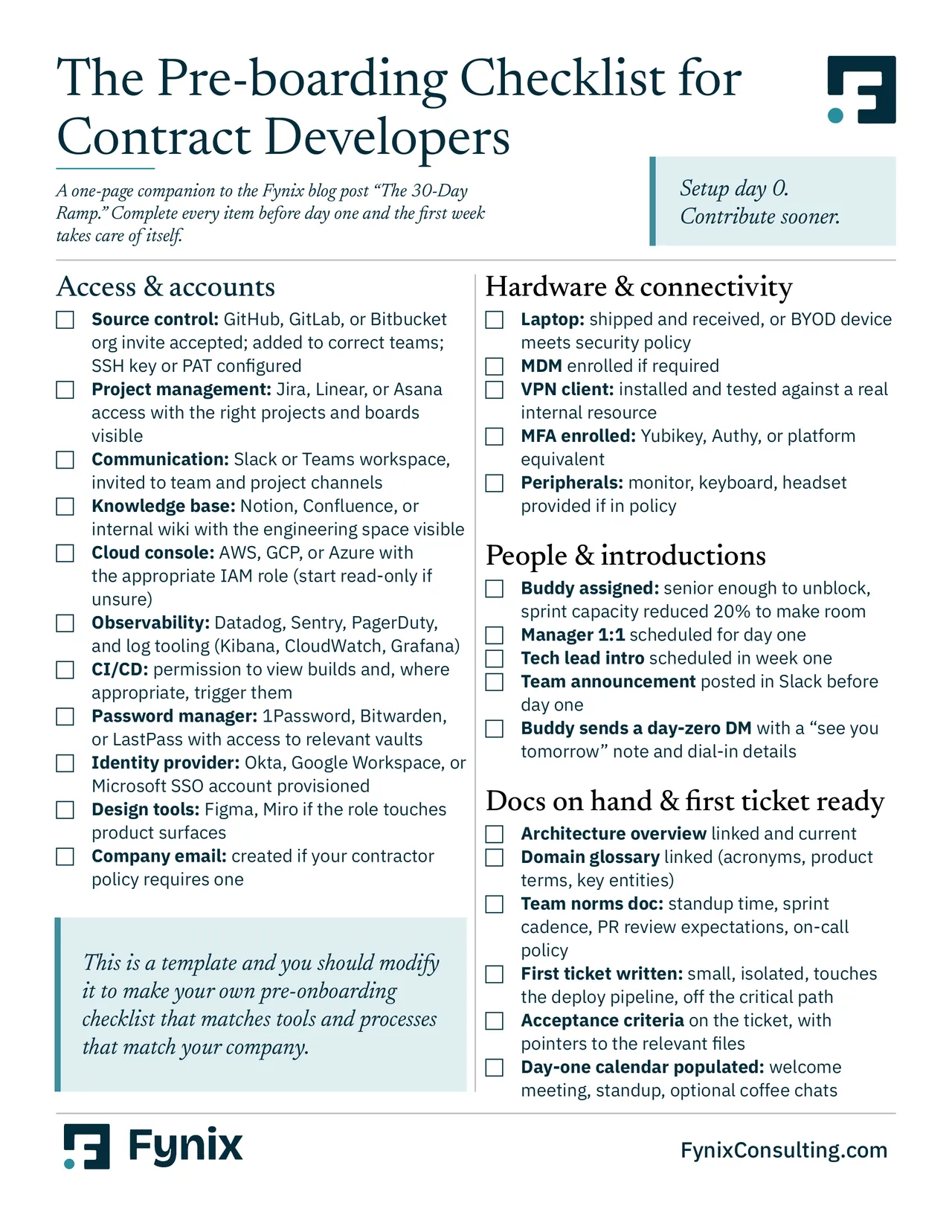
STAFF AUGMENTATION · ONBOARDING CHECKLIST
The Pre-boarding Checklist for Contract Developers
Access, environment, expectations, points of contact and the first assignment — every item worth closing before your contractor’s first morning.
Give it to whoever owns your next onboarding.